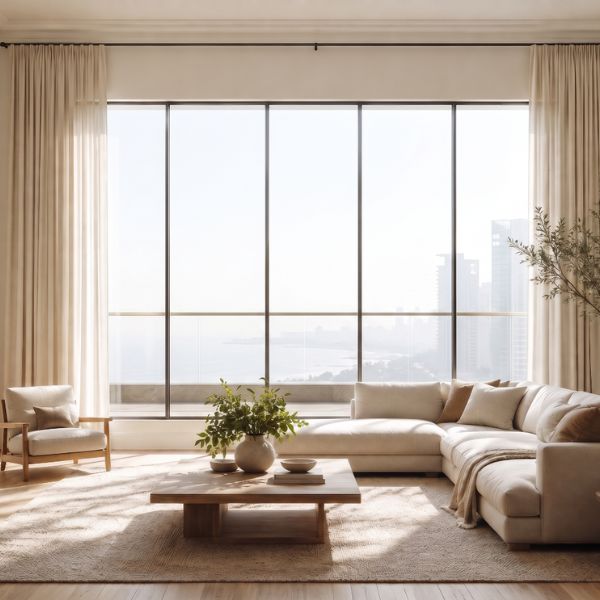
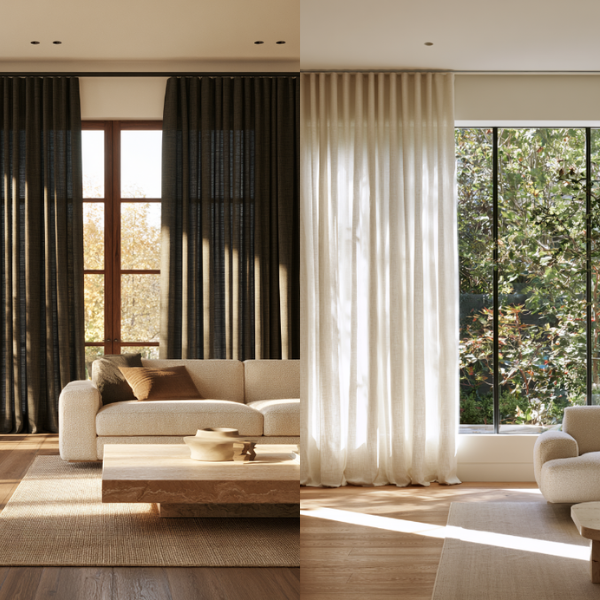
Motorised curtains are a practical upgrade for large windows, heavy fabrics, double-height spaces and curtains that are opened and closed several times a day.
They reduce manual effort, allow remote or scheduled operation, minimise unnecessary handling and make it easier to control daylight, glare, privacy and blackout throughout the day.
What Are Motorised Curtains?
Motorised curtains, also known as automatic, electric or smart curtains, open and close through an electrically operated curtain track.
Instead of pulling the fabric by hand, homeowners can operate the curtains using:
-
A handheld remote
-
A wall-mounted switch
-
A mobile application
-
Voice control
-
Smart-home automation
-
Preset opening and closing schedules
Motorisation can be used for sheer curtains, main curtains, blackout curtains and layered curtain arrangements. Depending on the track configuration and room layout, the curtains may open from the centre, stack towards one side or operate as separate panels.
For small, lightweight and easily accessible curtains, a manual track may be perfectly adequate. Motorisation becomes far more valuable when the curtains are wide, heavy, difficult to reach or frequently operated.

How Do Motorised Curtains Work?
A motorised curtain system consists of a specialised curtain track, internal carriers or runners, a curtain motor, a suitable power source and a chosen control method.
The curtain panels are attached to carriers inside the track. When the system is activated, the motor moves these carriers along the channel, allowing the curtains to open or close at a controlled speed.
The motor is generally positioned at one end of the track. Depending on the interior design, it may be concealed behind the curtain, installed inside a pelmet or accommodated within a recessed ceiling provision.
The system can also be programmed according to the homeowner’s routine. For example, blackout curtains may open automatically in the morning and close after sunset, while the sheers remain drawn during the day to provide privacy and soften natural light.
Although everyday operation is simple, the system itself must be specified carefully. Motor capacity, curtain weight, track quality, opening direction and installation alignment all influence how smoothly and reliably the curtains perform.

Why Motorised Curtains Are Genuinely Useful
Motorised curtains are often associated with luxury interiors, but their real value lies in how they improve the everyday use of curtains.
They are especially useful for wall-to-wall curtains, floor-to-ceiling windows, double-height spaces, large sliding doors and windows positioned behind beds, sofas or other furniture. They can also make curtain operation easier for elderly family members, children and people with limited mobility.
The larger, heavier or more inaccessible the curtain, the more practical motorisation becomes.

1. Effortless Everyday Convenience
Curtains are often operated several times throughout the day.
You may open the blackout curtains in the morning, adjust the sheers during the afternoon and close the main curtains again at night. Repeating this manually can become inconvenient, particularly when the fabric is heavy or the window spans a large section of the wall.
With a motorised curtain system, the curtains can be opened or closed at the press of a button. This makes it easier to manage morning daylight, afternoon glare, daytime privacy and nighttime blackout without repeatedly handling the fabric.
Motorisation is particularly helpful for windows that are 10 to 12 feet wide, tall installations and spaces where furniture restricts access to the curtains.
The purpose is not simply to add technology to the room. It is to make an everyday action effortless.

2. Smooth and Consistent Curtain Movement
Manual curtain operation is rarely completely even.
People may pull the curtain from one corner, grip the leading edge tightly or apply additional force when the track does not move smoothly. Heavy panels may also be left partially open because pulling them across the full span requires effort.
A correctly specified motorised track moves the curtain at a controlled and consistent speed. The movement is distributed through the system rather than concentrated on one section of the fabric, allowing the panels to open and close more evenly.
This is particularly useful for wide curtain spans, heavy blackout fabrics, floor-to-ceiling curtains, ripple pleats and layered curtain systems.
However, the motor cannot compensate for a poor-quality or incorrectly aligned track. The curtain channel, internal runners, supports and motor capacity must all be suitable for the total weight of the curtains.
3. Better Fabric and Pleat Care
Curtains are stitched to create a particular fall, fullness and pleat structure.
Repeatedly grabbing or pulling the fabric from one side can gradually disturb this arrangement. The effect is especially visible with ripple and wave pleats, where consistent spacing is essential to the finished appearance.
A motorised system follows the same controlled movement each time the curtains are opened or closed. Because the fabric is not repeatedly twisted, pulled or gripped at the leading edge, there is less pressure on frequently handled sections.
This can help reduce uneven stretching, disturbance to the pleats, twisting near the heading and wear caused by forceful pulling.
Motorisation does not replace quality fabric, good stitching or professional installation. It does, however, reduce unnecessary handling and can help the curtains retain their intended appearance for longer.

4. Cleaner Curtains With Less Handling
Curtains are touched more often than many homeowners realise.
Opening and closing them several times a day means repeatedly gripping the same section of fabric. Natural oils, dust, moisture and residue from the hands may gradually leave visible marks, particularly on light-coloured curtains.
The leading edge may begin to look dirtier than the rest of the panel, resulting in more frequent spot cleaning or additional washing and dry-cleaning.
Motorised curtains reduce the need to touch the fabric during everyday use. They will still require periodic cleaning, but minimising direct contact can help them remain fresh and presentable for longer.
This benefit is especially noticeable with white, ivory, beige and other pale curtain fabrics.
5. Improved Accessibility
Large or heavy curtains may be difficult for elderly family members to pull. People with limited mobility may also find it uncomfortable to stretch, grip or move full-height panels.
Children may struggle to operate large curtains safely, while curtains installed behind beds, sofas or tables can be difficult for anyone to reach comfortably.
A remote, wall switch or voice-controlled system removes much of this physical effort. This makes motorisation particularly useful in bedrooms, double-height living rooms, home theatres, large villas and homes designed for greater accessibility.
Accessibility should ideally be considered before the curtain hardware is finalised, not after the curtains have already been installed.

6. Easier Control of Light, Privacy and Glare
Curtains influence the amount of daylight, glare and privacy within a room.
Motorisation makes it easier to adjust them according to changing conditions throughout the day. Curtains can be programmed to open in the morning, close during harsh afternoon sunlight, provide privacy after sunset or create blackout conditions at bedtime.
In a layered arrangement, the sheers may remain closed during the day to soften light and provide privacy, while the blackout curtains operate only when stronger light control is required.
This can be particularly valuable in bedrooms, home theatres, west-facing rooms and spaces with large areas of glazing.
The curtains are also more likely to be used correctly when operating them does not require physical effort.
7. Ideal for Large, Heavy or High Windows
The larger the curtain installation, the more useful motorisation becomes.
Wide spans require more fabric, increasing the total weight of the curtain panels. Moving these panels manually every day can require considerable effort, even when the track is functioning properly.
Motorisation is especially practical for wall-to-wall curtains, floor-to-ceiling windows, double-height spaces, large sliding doors, corner glazing and windows positioned above staircases or behind large furniture.
In such situations, motorisation is not merely a decorative upgrade. It may be the most comfortable and consistent way to operate the curtains.

8. A Neater and More Premium Finish
Motorised curtains create a smooth and coordinated movement that contributes to the overall finish of the room.
The panels open and close evenly, the pleats remain better organised and the curtain is less likely to be left partially gathered. This is particularly effective in formal living rooms, master bedrooms, home theatres, premium apartments and villas with wide glazing.
However, the premium appearance does not come from the motor alone.
Fabric fullness, pleat style, curtain height, track quality, stitching and installation must all work together. A poorly aligned track or unsuitable motor may still create uneven movement, regardless of how expensive the system is.
Motorisation should therefore be treated as part of the complete curtain design rather than as an accessory selected at the end.
What Are the Limitations of Motorised Curtains?
Motorised curtains offer meaningful benefits, but they may not be necessary for every window.
They involve a higher initial investment than a manual track because the system includes the motor, specialised channel, controls, electrical provision and installation. Wired systems also require a power point close to the motor, which should ideally be planned before the ceiling, pelmet or wall finishes are completed.
Like any electrical or mechanical system, a curtain motor may occasionally require inspection or servicing. Performance also depends heavily on correct installation. A powerful motor cannot compensate for a bent, poorly aligned or unsuitable curtain track.
Noise can become an issue when the motor is underpowered, the track is incorrectly supported or the internal runners are of poor quality. A properly selected and professionally installed system, however, should operate smoothly and with limited noise.
Motorisation may also be unnecessary for a small, lightweight curtain that is easy to reach and rarely operated.
These limitations do not reduce the usefulness of motorised curtains. They simply reinforce the importance of selecting them for the right windows.
What Determines the Cost of Motorised Curtains?
There is no single fixed price for motorised curtains because each installation has different technical requirements.
The cost may depend on:
-
Length of the curtain track
-
Motor brand and capacity
-
Combined curtain and lining weight
-
Number of motorised layers
-
Centre-opening or one-way operation
-
Remote or smart-home controls
-
Wiring requirements
-
Pelmet or ceiling modifications
-
Installation height
-
Accessibility of the window
-
Existing site conditions
A lightweight bedroom curtain will require a different system from a wide living-room installation with separate sheer and blackout layers.
When two layers are installed, homeowners may choose to motorise both curtains or only the layer that is operated more frequently. Motorising both generally requires separate tracks and separate motors.
The most suitable system is not necessarily the most expensive one. It is the system correctly specified for the total curtain weight, width and everyday usage.
A site assessment is therefore more useful than comparing motor prices alone.
What Must Be Planned Before Installation?
Motorised curtains should be planned alongside the fabric, stitching, electrical work and ceiling design.

The curtain weight is particularly important. Heavy blackout fabrics, velvet curtains and layered systems generally require greater motor strength than lightweight sheers.
The number of layers also affects the track configuration. In a living room with separate sheer and blackout curtains, each layer requires its own channel. Depending on how the room is used, homeowners may choose to motorise both or only the heavier main curtain.
Power-point placement should ideally be planned before completing the false ceiling, pelmet, wall finishes or built-in furniture. Early planning helps prevent exposed wiring and unnecessary civil work later.
A false ceiling is not compulsory. Motorised tracks can be installed directly on the ceiling, mounted on the wall, placed inside a pelmet or accommodated within a recessed provision.
Can Existing Curtains Be Motorised?
Existing curtain fabric can sometimes be reused with a motorised system, although the current track will usually need to be replaced.
The curtain weight, heading style, hooks, stitching condition, available installation space and electrical provision must all be assessed before conversion.
Alterations may be required if the curtain heading or fullness is not compatible with the new motorised track. The existing pelmet may also need to be checked to ensure there is enough space for the motor and channel.
A site inspection is the most reliable way to determine whether existing curtains can be motorised without replacing the fabric.
Can Motorised Curtains Connect to Smart-Home Systems?
Some motorised curtain systems can connect to compatible home-automation platforms, mobile applications and voice-control devices.
Compatibility depends on the motor, control module and communication system being used. Homeowners should confirm whether an additional hub is required, whether the motor supports the preferred platform and whether the system will continue to function through a remote or wall switch if the internet connection is interrupted.
Smart-home compatibility should be verified before the motor is purchased rather than assumed after installation.
Plan the Fabric, Track and Motor Together
Curtain fabric and curtain hardware should never be selected independently.
A beautiful fabric requires the correct fullness, stitching, track, motor, brackets and installation to perform as intended. Similarly, a premium motor cannot compensate for incorrect measurements, unsuitable curtain construction or inadequate installation space.
At D’Moksha Homes, our curtain designers assess the window dimensions, fabric and lining weight, number of curtain layers, pleat style, track configuration, opening direction, electrical provision, ceiling space, furniture placement and daily usage before recommending a system.
This allows the curtain fabric, track and motorisation to be planned as one complete solution rather than as separate last-minute decisions.
Motorised curtains are genuinely useful when they are selected for the right window and installed correctly. They simplify everyday operation, reduce unnecessary fabric handling, improve accessibility and make large or heavy curtains significantly easier to use.
Book an At-Home Curtain Consultation
Planning motorised curtains for your home?
Book an at-home curtain consultation with D’Moksha Homes. Our designers assess the curtain weight, window width, fabric layers, track configuration, opening direction and electrical provision before recommending the right system.
This helps ensure that your motorised curtains do not simply look premium—they also move smoothly and perform reliably every day.