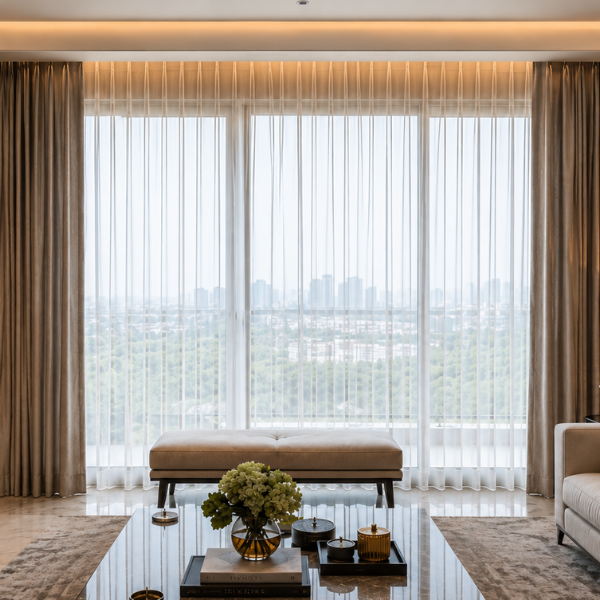
You invest in good blackout curtains expecting a dark, comfortable room. The fabric is thick, the curtains look beautiful and they may even have been sold to you as a complete blackout. Yet every morning, there is still a thin line of sunlight coming through the centre. These blackout curtain light gaps can be frustrating, especially when you have invested in good-quality fabric and expected a much darker room.
So, why are your blackout curtains still letting light in? The problem may not be the blackout fabric at all. A curtain is more than the fabric you choose. Just as buying an expensive fabric does not automatically result in a perfectly fitted outfit, choosing premium blackout fabric does not automatically result in effective blackout curtains. Stitching, curtain width, track, overlap, height, pelmet and installation all affect how much light eventually enters your room.
The Fabric Can Block Light. The Curtain System May Not.
When buying blackout curtains, most of the attention naturally goes towards the fabric. Does it block enough light? Is it lined? Is it a true blackout or a dimout? What colour should you choose? All of these questions matter, but once you have chosen the right fabric, the next question should be: how will the curtain be stitched and installed around the window?
Light does not necessarily have to pass through your curtain fabric. It can simply travel around it. That is why you may see a bright vertical line between two curtain panels or light entering from the sides, top or bottom even when the fabric itself performs well. If you are trying to solve blackout curtain light gaps, start by looking at the entire window rather than replacing the fabric immediately.

1. Check the Gap Between Your Curtains
One of the most visible problems is the light gap between curtains at the centre. With a conventional curtain installation, two panels often close until their edges meet. This may look perfectly fine during the day, but when strong sunlight is behind them, even a small opening between those panels becomes noticeable.

For better light control, the curtains should not simply meet edge-to-edge. Depending on the window, curtain style and level of darkness required, they should be planned with enough centre overlap to minimise the gap when closed. This can significantly reduce the vertical strip of light between your blackout curtains.

It is also why the width and fullness of your curtains need to be planned before stitching. If there is not enough fabric available, creating the required centre coverage later may become difficult.
2. Your Blackout Curtain Track Matters
The blackout curtain track is another part of the system that is easy to overlook. A standard track may bring both curtain panels towards each other but still leave them meeting at the centre. Where greater darkness is required, an overlapping track arrangement can allow one curtain to travel slightly behind the other when the curtains are closed.
An S-channel setup designed with the right centre overlap, or another suitable overlapping track system, can therefore provide better coverage than a basic edge-to-edge closing arrangement. Two curtains can use exactly the same blackout fabric and still perform very differently depending on their track and installation. The hardware is not simply there to hold the curtain; it also affects how effectively the curtain closes.

3. Light Can Also Enter From the Sides
Even after the centre gap is addressed, daylight may still enter from the sides. If the curtain or track finishes too close to the edge of the window, sunlight can travel through the space between the curtain and the wall.

This is why track extension beyond the window, curtain width and the position of the curtain relative to the window should be planned together. Depending on the level of darkness required, the track may need to extend further beyond the window so that the curtain provides better side coverage when closed. A curtain that perfectly matches only the width of the glass may not necessarily provide the light control you expect.

4. Don't Forget the Top of the Curtain
Another common source of light is above the curtain. Depending on the track position and ceiling construction, daylight can travel through the space between the curtain heading and the wall or ceiling.

This is where the pelmet can become functional rather than purely decorative.

5. Curtain Height and Drop Matter Too
The bottom of the curtain can be another source of light. If a blackout curtain finishes significantly above the floor or window sill, daylight can enter beneath it. The right curtain drop level depends partly on the look you want and partly on the amount of darkness you are trying to achieve.
A living room where you simply want to reduce glare may have a very different requirement from a bedroom where morning sunlight affects your sleep. That is why there is no universal specification for the perfect blackout curtain.
How Dark Do You Actually Want the Room?
Before finalising your blackout curtain installation, tell your curtain expert exactly what you expect from the room. You may simply want to reduce harsh sunlight, make the room noticeably darker during the afternoon or achieve the maximum possible darkness in a bedroom, nursery or media room.

The more stringent your requirement for darkness, the more carefully the details need to be planned. A Curtain Stylist can then recommend the appropriate hang style, curtain overlap, track configuration, track extension beyond the window, curtain height and drop, side coverage, pelmet depth and curtain fullness. For greater blackout performance, all of these elements need to work together.
Good Blackout Curtains Are About More Than Fabric
Choosing curtains only by looking at fabric can be misleading. You may select a premium blackout fabric, but if the measurements, stitching and installation have not been planned for the level of darkness you expect, you can still end up with light coming through your blackout curtains.
The fabric may be doing exactly what it is supposed to do; the light may simply be travelling around it. A well-planned blackout curtain therefore starts with understanding the window, the room and the required level of darkness, and then planning the fabric, fullness, track, pelmet and installation accordingly.
The D'Moksha Approach to Blackout Curtains
At D'Moksha, our curtain stylists come to your home to understand your room, your windows and the level of light control you need. From fabric and styling to measurements, tracks, stitching and installation, the complete curtain is planned as one system rather than as separate decisions.
We control the process from selection through stitching to final installation under one brand, helping ensure that details such as overlap, drop, pelmet and track configuration are considered before the curtain is made. Because premium fabric is only one part of a great curtain; how it is stitched, styled and installed completes the result.