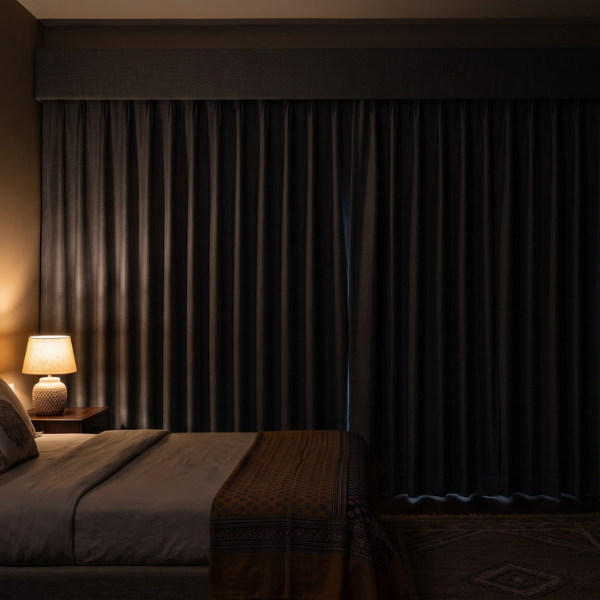
When planning curtains, most of the attention naturally goes to the fabric, colour, texture and pleat style. But one of the most important decisions is often made before the curtains are even selected: how much space is available inside the pelmet.
Pelmet depth, curtain track spacing and the distance between a sheer and main curtain can all influence how the finished curtains fall, move and stack. If there is too little room, the fabrics can begin to interfere with one another. If there is unnecessarily too much room, the pelmet can become larger than the curtain system actually requires.
This is why curtain pelmet size is not simply a carpentry measurement. It is closely connected to the type of curtains that will eventually sit inside it.

Why Double Curtain Track Spacing Matters
A double-curtain arrangement usually combines a sheer curtain closer to the window with a main or blackout curtain in front. Although the curtain tracks themselves occupy very little space, the curtains hanging from them do not.
Once fabric is stitched into pleats, it develops depth. The folds of the sheer project forward, while the folds of the main curtain project backwards. Both layers therefore need enough separation to form naturally without constantly pressing into one another.
As a broad planning guideline, many double-curtain arrangements need roughly 4 to 5 inches of separation, although the exact requirement depends on the pleat style, fullness, fabric weight and track system being used.
The important consideration is not simply the distance between two pieces of hardware. It is whether there is enough usable space for both sets of curtain folds once the fabrics are actually hanging.

What Happens When Curtain Tracks Are Too Close Together
Curtain tracks that appear comfortably spaced when they are empty can behave very differently once several metres of fabric are suspended from them.
When the tracks are positioned too close together, the front curtain can begin to push against the sheer behind it. The fabrics may rub when the curtains are opened and closed, the sheer can become compressed, and the folds may not return easily to their intended position.
The visual effect can be surprisingly noticeable. Instead of two clearly defined curtain layers, the treatment can begin to look dense or crowded. Sometimes this is mistaken for poor stitching or the wrong fabric, when the underlying problem is simply that the curtains do not have enough room to fall properly.
This is one reason the space between two curtain tracks can have such a large impact on the finished appearance.

How Pelmet Depth for Double Curtains Is Determined
For many conventional double-curtain arrangements, a pelmet depth of around 8 to 10 inches can provide sufficient room for the two tracks and curtain layers.
That measurement, however, is better understood as a general reference than as a fixed standard.
The depth required depends on what is actually being installed inside the pelmet. A relatively lightweight sheer combined with a conventional pleated main curtain may occupy considerably less space than two fuller curtains made from heavier fabrics.
The pelmet therefore has to accommodate not only the tracks themselves but also the volume created by the curtain headings and folds.

Why Ripple Curtains Can Need More Pelmet Depth
Pleat style is one of the biggest reasons there is no single pelmet size that works for every double curtain.
ripple curtains, for example, create a continuous S-shaped formation along the track. That ripple needs depth both in front of and behind the track to maintain its shape. When two ripple curtains are installed together, the space requirement can increase further.
For this reason, double ripple-curtain arrangements can sometimes require more than the 8 to 10 inches that may work for conventional pleated curtains, particularly when the fabrics are heavy or the curtains have generous fullness.
Pinch pleats, pencil pleats and other curtain headings create different fold profiles, so their spatial requirements can also vary. The question is therefore less about finding one universal pelmet dimension and more about matching the pelmet depth to the curtain construction.

Fabric and Fullness Change the Space Required
Even with the same pleat style, two curtains can occupy very different amounts of space.
A lightweight sheer forms softer, narrower folds than a thick blackout fabric. A lined curtain will generally have more volume than an unlined one. Increasing the fullness means more fabric is being used across the same window width, which can create deeper or more numerous folds.
These differences become particularly important in a double-curtain setup because both layers are sharing the same pelmet.
This is why pelmet depth for double curtains cannot be determined from the window width alone. Fabric thickness, lining, fullness, heading style and track construction all contribute to the amount of room needed.
More Pelmet Depth Is Not Automatically Better
It might seem logical to simply make the pelmet much deeper and eliminate the risk of insufficient space. But more depth is not necessarily an improvement.
An oversized pelmet can take up unnecessary ceiling space and can affect the proportions of the room, especially where the ceiling height is limited or the curtain pocket is integrated into a false ceiling.
The most successful arrangement is usually one where the pelmet is proportionate to the curtain system it contains. The objective is enough room for both layers to move and form properly, rather than the maximum possible amount of space.
In other words, curtain pelmet size works best when it is considered as part of the overall curtain design rather than as an isolated construction detail.
Why Pelmet Planning Often Needs to Happen Early
One reason curtain spacing problems occur so frequently is the sequence in which interiors are completed.
False ceilings and pelmets are often designed during the carpentry or ceiling stage, while curtain fabrics, tracks and pleat styles may be finalised much later. By the time the exact curtain specification is known, the available depth may already be fixed.
That can create a mismatch between the curtain that has been selected and the space that was created for it.
This is particularly relevant for concealed tracks and ceiling-mounted curtain systems, where the track position is integrated into the architecture of the room. In these cases, the intended curtain configuration can affect the ceiling detail long before the final fabrics are installed.
Whether the window will have a single curtain, a sheer with a blackout curtain, a conventional pleat or a ripple system can therefore influence the amount of space required at the planning stage itself.
The Pelmet Is Part of the Curtain System
A finished curtain is the result of several elements working together. Fabric, fullness, pleat style, track type, spacing, pelmet depth, curtain height and installation all influence the way it eventually looks and performs.
The pelmet happens to be one of the least visible parts of that system, but its effect can be seen in the way the curtain hangs.
When the spacing is appropriate, the sheer and main curtain can form their folds independently, move without excessive friction and stack more comfortably when opened. When the available space does not match the curtain construction, even an otherwise well-made curtain can appear crowded.

That is why understanding pelmet depth, curtain track spacing and the space required for double curtains is an important part of understanding the curtain itself.
The space behind the curtain may not be visible once the room is complete, but it plays a significant role in how everything in front of it finally looks.