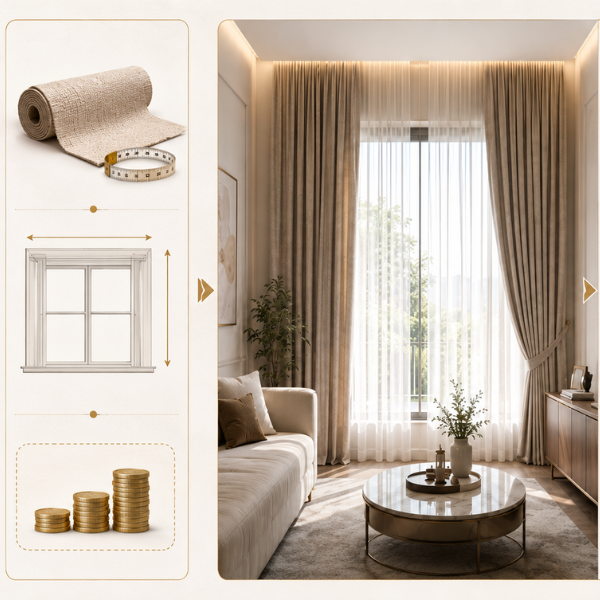
Choosing an expensive curtain fabric does not automatically guarantee a luxurious result.
The way curtains finally look in a room depends on much more than the fabric’s price. Its weight, texture, colour, fall, and interaction with light all influence the finished appearance. A fabric that looks premium as a small swatch or under showroom lighting can feel completely different once it covers an entire window.
So, if you are wondering how to choose curtain fabric or how to make curtains look more expensive, start by avoiding these three common mistakes.

1. Choosing the Wrong Curtain Fabric Weight
Fabric weight plays an important role in how curtains fall and hold their shape.
For certain main-curtain fabrics, weights around 250–350 GSM can create a fuller, more substantial fall. But GSM should never be treated as a measure of luxury on its own. The fibre, weave, lining, fullness, and intended curtain style matter just as much.
The goal is not to choose the heaviest fabric possible. It is to choose the right weight for the curtain you want to create.
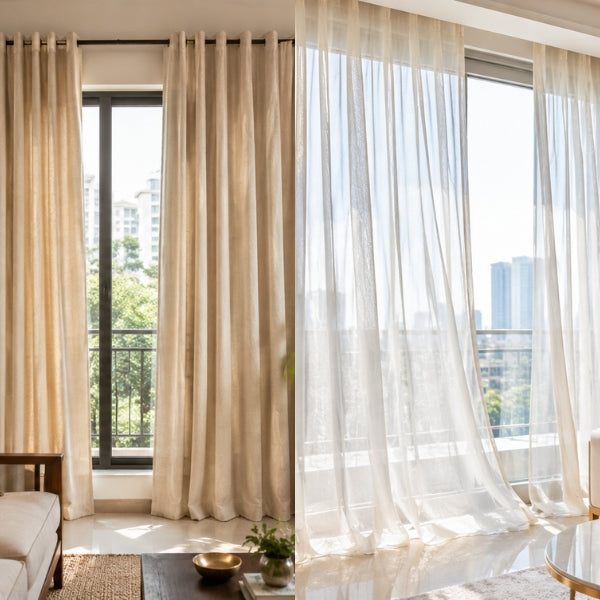
For example, a main curtain designed to look structured and substantial will usually need more body than a soft sheer curtain intended to filter natural light.
If the fabric is too lightweight for the intended design, the curtain may appear flat, flimsy, or lack the structured fall you expected—even if the fabric itself was expensive.
When selecting the best curtain fabric for your home, consider:
-
How the fabric falls at full length
-
Whether it holds the desired folds
-
How much structure you want
-
Whether it will be lined
-
The intended fullness of the curtain
-
Whether it is being used as a sheer or main curtain
The right curtain fabric is not necessarily the most expensive or the heaviest. It is the one that behaves correctly for your window and design.

2. Focusing on Shine Instead of Texture
One of the biggest misconceptions around luxury curtains is that a shiny fabric automatically looks more premium.
In reality, texture often creates a much stronger sense of luxury.
Highly reflective fabrics can sometimes look visually flat because light reflects evenly across their surface. Some synthetic fabrics may have plenty of shine but still lack the visual depth that makes curtains feel sophisticated.
Textured fabrics interact with light differently.
Velvet, soft woven materials, and fabrics with subtle slubs or surface variations create small areas of light and shadow. When these fabrics are used across a full-height curtain, that variation creates depth and makes the fabric feel richer.
When choosing curtain fabric, look for details such as:
-
Soft woven textures
-
Subtle slubs
-
Natural-looking surface variations
-
Matte or low-sheen finishes
-
Fabrics that change subtly as light moves across them
This does not mean shiny fabrics should never be used. The right sheen can work beautifully in certain interiors.
The important thing is not to confuse shine with luxury.
Often, the most sophisticated curtains are the ones where texture reveals itself gradually rather than demanding attention immediately.

3. Choosing Curtain Colours Without Considering the Room
Curtain colour should never be chosen in isolation.
A shade that looks attractive on a swatch may feel completely different when repeated across a large window. Your wall colour, flooring, furniture, natural light, and overall interior palette can all change how that colour is perceived.
For a quieter and more sophisticated look, muted colours are often easier to integrate into a room.
Popular choices include:
-
Ivory
-
Champagne
-
Warm beige
-
Taupe
-
Soft grey
-
Muted earthy shades
These tones can allow the texture and fall of the curtain fabric to remain visible rather than letting colour dominate the entire window.

But luxury is not limited to neutrals.
Deep greens, blues, rusts, or other stronger colours can also look extremely refined when they are chosen intentionally and balanced with the rest of the room.
The mistake is not choosing a bold colour.
The mistake is choosing a colour simply because it looks attractive on its own without considering how it will behave at scale in your interior.

Why Small Curtain Fabric Swatches Can Be Misleading
Curtain fabric is often selected from a small swatch, but that swatch tells only part of the story.
It may help you understand the basic colour and texture, but it cannot fully show how the fabric will look once it is stitched, gathered, and installed from ceiling to floor.
At full length, several characteristics become much more noticeable:
-
The weight and fall of the fabric
-
The depth of its texture
-
How the colour changes across folds
-
How natural light passes through or reflects from it
-
How it looks beside your furniture and walls
-
Whether it feels too heavy or too light for the room
Lighting makes an especially big difference.
A fabric that looks warm under showroom lighting may look cooler in your home. A grey may appear slightly blue in one room and warmer in another. A textured fabric may look subtle indoors but develop much more depth when sunlight falls across it.
That is why the most accurate place to evaluate curtain fabric is inside the room where it will eventually be installed.

How to Make Curtains Look More Expensive
Making curtains look luxurious does not necessarily mean spending more on fabric. It means paying attention to how all the elements work together.
Choose the right weight
Select the weight according to the type of curtain and the fall you want rather than assuming heavier is always better.
Look for depth in the texture
Observe how the fabric reacts to natural and artificial light. A subtle texture can often create more visual richness than excessive shine.
Choose colour within the room
Compare curtain colours against your walls, flooring, furniture, and existing décor instead of judging them on a sample card alone.
See the fabric at scale
Whenever possible, evaluate a larger or full-length sample. Curtain fabric behaves very differently across an entire window than it does as a small swatch. These details are what help create curtains that feel considered, balanced, and premium.
Why Full-Length Curtain Samples Make a Difference
At D'Moksha, we believe curtain selection should happen where the curtains will actually live—in your home.
During a home consultation, our designers bring around 20–25 full-length curtain samples so you can compare fabrics against your actual windows and interiors.
This allows you to see the things a tiny swatch cannot show.
You can observe:
-
How the fabric falls
-
How its texture responds to light
-
Whether the colour complements your walls
-
How substantial it looks against your window
-
How it coordinates with furniture and flooring
-
How different options change the overall mood of the room
A curtain that looks perfect in a showroom may feel completely different in your own space.
Seeing full-length options at home removes much of that guesswork.
Expensive Fabric Alone Does Not Create Luxury Curtains
The price of a fabric can reflect its material, construction, craftsmanship, or quality, but it cannot guarantee that the finished curtain will look right in your room.
What matters is how everything works together.
Weight creates the fall.
Texture creates depth.
Colour creates balance.
And the room itself provides the context.
When these elements are chosen thoughtfully, curtains can look refined and luxurious without needing to be overly flashy or excessively expensive.
When they are ignored, even a costly fabric may not produce the result you imagined.
Before finalising your curtains, see how the fabric behaves in your actual space.
Book a free D'Moksha home visit, explore full-length curtain samples in your own room, and choose your curtains with complete confidence.