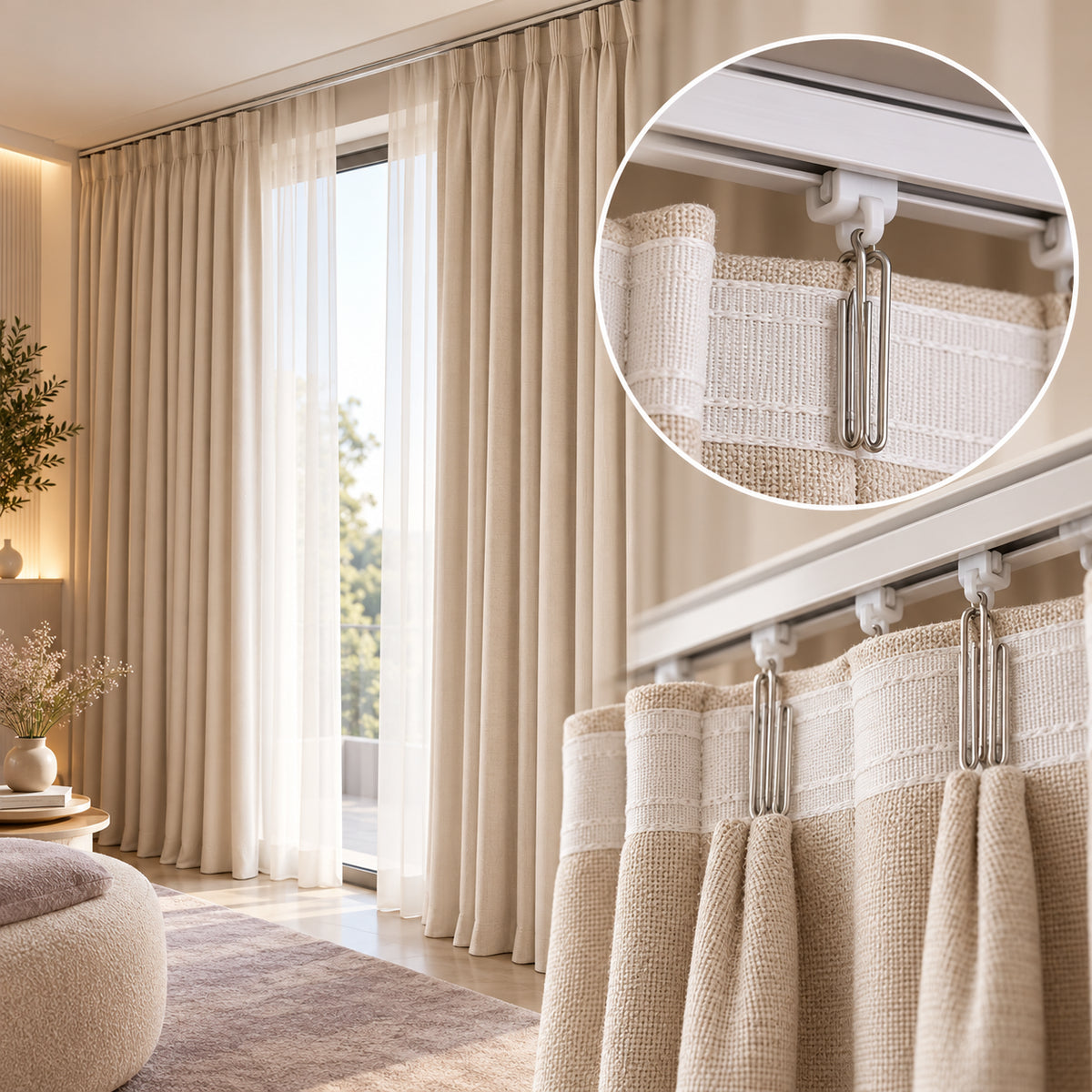

Curtains do much more than cover a window. They influence how light enters a room, create privacy, soften the overall look of a space and can even change how large, warm or comfortable a room feels.

With so many types of curtains available today, however, choosing the right one can become confusing. Should you choose airy sheer curtains for the living room or heavier curtains for more privacy? Are linen curtains suitable for everyday use? Do eyelet curtains work with every window? And should you choose readymade curtains or have curtains customised for your space?
The answer depends on your room, the amount of natural light it receives, how you use the space and the overall look you want to create. The best curtain choice usually comes from considering several things together: fabric, light control, privacy, heading style, fullness, length and hardware.
This guide explores the most important curtain types and the practical factors to consider before making your choice.
Understanding the Different Types of Curtains
When people talk about different types of curtains, they may actually be referring to different aspects of curtain design.
Curtains can be classified according to their fabric, opacity, heading or pleat style, construction and method of installation. For example, sheer and blackout describe how a curtain interacts with light. Linen describes the material or appearance of the fabric. Eyelet refers to the curtain heading, while readymade and custom curtains describe how the curtain is produced.
This is why choosing curtains is rarely about selecting just one feature. A well-planned curtain brings the right fabric, heading, fullness, length and hardware together for the specific window and room.
1. Sheer Curtains: Light, Airy and Versatile
Sheer curtains are one of the most versatile options for modern homes. Made from lightweight or semi-transparent fabrics, they are designed to filter daylight rather than block it completely.
Their biggest advantage is the way they soften natural light. Strong sunlight coming directly through a window can feel harsh, particularly during brighter parts of the day. Sheers diffuse this light, helping the room feel softer while still allowing daylight to enter.
Sheer curtains work particularly well in living rooms, dining areas and other spaces where you want to maintain brightness without leaving the window completely uncovered. They can also provide a degree of daytime privacy, although this depends on factors such as the weave, colour and transparency of the fabric.

For bedrooms or rooms where greater privacy is required, sheers are often paired with main curtains or blackout curtains. During the day, the heavier curtains can remain open while the sheers continue filtering light. At night, the main curtains can be closed for more privacy.
The appearance of sheer curtains can vary significantly too. Plain sheers create a clean, understated look, while textured, patterned or embroidered sheers can introduce visual detail without making the room feel heavy.
Because sheers usually cover a large area of the window, scale is important. A small swatch may show the colour or weave of the fabric, but it may not fully communicate how transparent or textured the curtain will appear once it covers the entire window.
2. Linen Curtains: Relaxed Texture with Timeless Appeal
Linen curtains are popular for their natural-looking texture and understated character.
Linen and linen-look fabrics work particularly well in interiors where the aim is to create a relaxed yet refined atmosphere. Rather than appearing completely flat or uniform, linen often has subtle surface variations that add visual depth.
These variations also help the fabric interact beautifully with natural light.
Lighter linen curtains can suit bright living rooms, bedrooms and dining areas, while heavier linen or linen-blend fabrics can create more privacy and greater visual presence.

It is important to remember that the term linen can refer to several different fabric constructions. Pure linen, linen blends and linen-look fabrics can behave differently in terms of drape, maintenance, light filtration and durability.
The heading also changes the overall effect. Linen used with a ripple or wave heading can produce clean, continuous folds, while a more tailored pleat can give the same fabric a more defined and formal look.
When choosing linen curtains, look beyond the colour. Consider how the fabric falls, how much light passes through it and how its texture works with the other materials and finishes in the room.
3. Blackout Curtains: Designed for Greater Light Control
Blackout curtains are designed to reduce the amount of outside light entering a room. They are commonly used in bedrooms, nurseries, home theatres and spaces that receive strong sunlight.
However, not every dark or heavy-looking curtain is automatically a blackout curtain.
The performance depends on the construction of the fabric and, in some cases, whether a blackout lining is added.

The installation matters as well. Even a highly effective blackout fabric can allow light to enter around the sides, centre or top of the window if the curtain does not provide enough coverage.
For this reason, blackout performance should be considered as part of the complete curtain system rather than through fabric alone. Curtain width, track placement, centre overlap, side coverage and overall length can all influence how much light enters the room.
Blackout curtains can also be layered with sheer curtains, allowing you to enjoy filtered daylight during the day and stronger light control when needed.
4. Eyelet Curtains: Simple and Familiar
Eyelet curtains have circular rings fitted into the upper portion of the curtain. A rod passes directly through these rings, allowing the fabric to form relatively even folds.
Their simplicity is one of the main reasons they are so widely used.
Eyelet curtains are easy to recognise, straightforward to install and commonly available among readymade curtains.
Visually, they usually create a casual and contemporary appearance. They can work particularly well in bedrooms, smaller windows and more informal living spaces.

However, eyelet curtains require a visible curtain rod. This may not be suitable if you want the hardware to remain discreet or if the room calls for a cleaner ceiling-mounted appearance.
The folds created by eyelets are also quite different from those created by ripple tracks or tailored pleats.
Before choosing eyelet curtains, consider whether the visible rings and rod work with the overall style of the room. The top of the curtain is more visually important than it may first appear, especially on full-height curtains.
5. Ripple or Wave Curtains: Clean, Continuous Folds
Ripple or wave curtains are designed to create consistent, flowing folds across the entire width of the curtain.
They generally require a compatible track system that controls how the fabric forms its waves.
This curtain style works especially well across wide windows, sliding doors and floor-to-ceiling openings because the repeated folds create rhythm without adding too much visual detail.
Ripple curtains can be made using both sheers and main curtain fabrics. This means both layers of a double-curtain arrangement can follow the same clean visual language.

The final effect depends heavily on the chosen fabric. A lightweight sheer will create softer waves, while a heavier fabric can produce deeper and more pronounced folds.
Fullness and hardware are especially important for this curtain type. The heading, track and amount of fabric all need to work together to achieve the intended appearance.
6. Pleated Curtains: Tailored and Defined
Pleated curtains include several different heading styles, including pinch pleats, American pleats, pencil pleats and box pleats.
Each of these distributes fabric differently and creates a different visual effect.
Pinch or tailored pleats create defined folds at the top of the curtain before allowing the fabric to fall more freely below. Pencil pleats create narrower gathered folds, while box pleats give the curtain a more geometric appearance.

Even when the same curtain fabric is used, changing the pleat can completely alter the finished look.
This is why curtain design is not simply about selecting a fabric. Fabric weight, pleat style, fullness and hardware have to work together.
Lightweight fabrics may create softer folds, while heavier fabrics can produce deeper and more pronounced shapes.
Window size matters too. A heading that works well on a smaller bedroom window may behave very differently across a wide sliding door or large floor-to-ceiling opening.
7. Readymade Curtains: Convenient but Standardised
Readymade curtains are manufactured in predetermined widths and lengths.
They are convenient, widely available and can work well when the dimensions of your window are close to standard curtain sizes.

Their biggest limitation, however, is fit.
Not every home has the same ceiling height, rod position or window proportions. Some windows may be wider, taller or positioned differently from the dimensions that readymade curtains are designed for.
If a readymade curtain is too short, too narrow or does not have enough fullness, the difference can become much more noticeable once the curtains are installed.

This is particularly true for large windows where the curtains cover a significant portion of the wall.
Readymade curtains can therefore be a practical option when convenience is the priority, but accurate measurement is essential before making a purchase.
8. Custom Curtains: Made Around the Window and Room
Custom curtains are made according to the dimensions and requirements of the specific space rather than being restricted to standard sizes.
This gives you greater control over the curtain height, width, fullness, fabric, heading and overall finish.

For example, the curtain can be made to finish just above the floor, touch the floor precisely or create a longer puddled effect depending on the desired look.
The amount of fabric can also be calculated according to the specific pleat style instead of being limited by a standard curtain width.
Customisation can be particularly useful for floor-to-ceiling windows, extra-wide openings, layered curtains and spaces where architectural proportions do not correspond with standard curtain sizes.
How to Choose Between Different Types of Curtains
Once you understand the different types of curtains, the next step is deciding what actually suits your space.
Instead of selecting a curtain simply because you like the colour or pattern, consider how the curtain needs to perform in the room.
Consider the Amount of Light
Start with the natural light entering the room.
A bright living room may benefit from sheer curtains that soften sunlight while keeping the space light and open.
A bedroom may require blackout curtains for greater light control.
In many spaces, combining sheers with main curtains gives you the best of both. The sheer layer can filter daylight during the day, while the main curtain can provide privacy and stronger light control when required.
Consider Privacy
Privacy requirements can change significantly depending on the room and its location.
A ground-floor window facing a road may require more coverage than a high-rise window facing an open view.
Sheer curtains can help provide some daytime privacy, but many sheer fabrics become more transparent at night when the lights inside the room are switched on.
If privacy is important throughout the day and night, a layered curtain arrangement may be more suitable.
Look at the Size of the Window
Window size has a direct impact on how a curtain should be designed.
Large windows require careful consideration of fabric weight, fullness and stacking space.
A curtain needs enough fabric to create the intended folds while also being able to open comfortably.
The wider the window, the more important it becomes to think about how much space the curtains will occupy when they are drawn to the sides.
Think About the Length
Curtain length has a major influence on the finished appearance.
Curtains that finish noticeably above the floor can create a very different impression from curtains that meet the floor precisely.
The correct length should be planned according to the window height, the position of the track or rod and the final look you want to achieve.
This becomes particularly important with floor-to-ceiling curtains because even a small difference in length can be visually noticeable.
Plan the Fullness
The finished width of a curtain is not the same as the amount of fabric used to make it.
Extra fabric is needed to create folds. This is known as fullness.
Depending on the heading, fabric and desired look, curtains may require approximately 1.5 to 2.5 times the finished width, or another ratio suited to the specific curtain construction.
Too little fullness can make curtains look flat and sparse. Too much fullness can make certain fabrics feel unnecessarily bulky.
The ideal amount should therefore be calculated according to the chosen curtain style rather than using the same ratio for every curtain.
Decide on the Hardware
Curtain hardware affects which heading styles are practical.
Eyelet curtains normally require a rod, while ripple or wave curtains generally need a compatible track system.
Other pleated curtains can also work with specific track or rod arrangements depending on their construction.
If curtain hardware is already installed, it is important to check whether it is compatible with the heading you want before finalising the curtain style.
Readymade Curtains vs Custom Curtains
Both readymade curtains and custom curtains have their place.
Readymade curtains can offer convenience when a window closely matches available sizes and the design requirements are relatively straightforward.
Custom curtains offer more flexibility.
They can be planned according to the actual height and width of the window, the required fullness, the curtain heading, hardware and overall design of the room.
These differences become especially noticeable on larger windows.
Because curtains occupy such a substantial visual area, small differences in length, fullness and proportion can have a much greater effect on the finished room than expected.
The Right Curtain Is More Than a Fabric Choice
Exploring different types of curtains is a useful starting point, but the best curtain comes from bringing several decisions together.
The fabric needs to work with the light.
The heading needs to suit the fabric.
The fullness needs to work with the pleat.
The hardware needs to support the chosen heading.
And the length and width need to suit the proportions of the window.
Whether you are considering sheer curtains, textured linen curtains, practical eyelet curtains, blackout fabrics or readymade curtains, it helps to think about the entire window rather than choosing each element separately.
Choosing Curtains the D’Moksha Way
At D’Moksha, curtains are curated around the room rather than chosen in isolation.
Our Stylists visit your home with full-length curtain samples, allowing you to see how different fabrics, colours and textures actually look against your window and in your own light.
Instead of trying to imagine the finished result from a small swatch, you can see the curtain at scale before making your decision.
The Stylist also helps bring together the other details that shape the finished curtain, including fabric selection, pleat style, fullness, dimensions and hardware.
Once the curtain is finalised, it is crafted to the specifications of your space at our factory and taken through to installation.
Because choosing the right curtains is not simply about finding a fabric you like. It is about finding the right combination of fabric, light, proportion and craftsmanship for the room.
D’Moksha | The Art of Curtains
Curated. Crafted. Assured.